
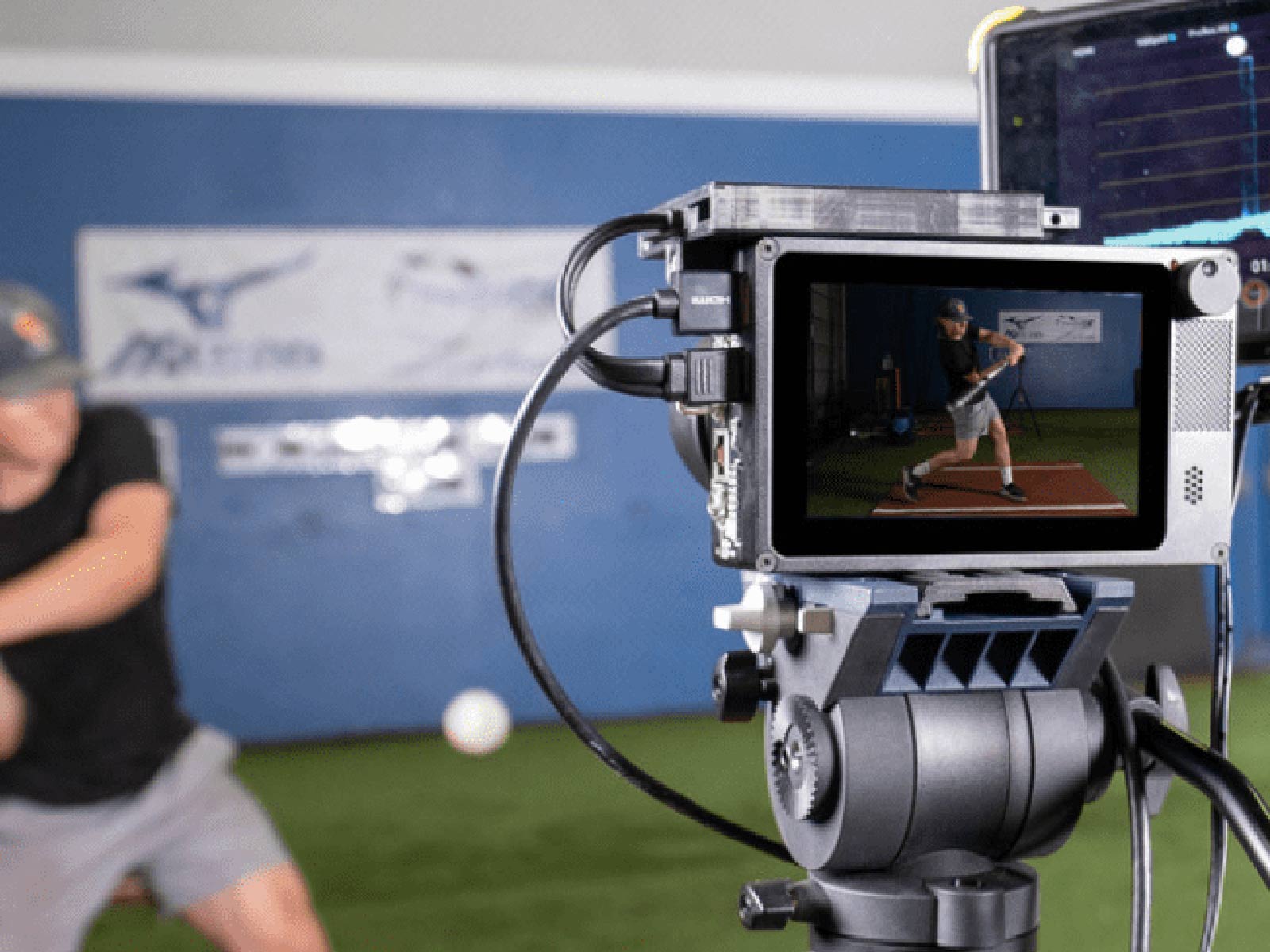
What Are High Speed Cameras: A Comprehensive Guide
If you have ever wondered how filmmakers capture a bullet piercing glass, how engineers study car crash impacts, or how scientists analyse the motion of a hummingbird’s wings, the answer lies in high speed cameras. These specialized imaging systems record motion at thousands or even millions of frames per second, revealing details too fast for the human eye or a normal camera to detect.
In this guide, we break down what high speed cameras are, how they work, and the key technologies that power them.
What Is a High Speed Camera?
A high speed camera is designed to capture video at extremely high frame rates far beyond the 24 to 60 fps recorded by most consumer or professional video cameras. Depending on the model, a high speed camera may capture anywhere from 1,000 fps to more than 1,000,000 fps.
At these speeds, events that normally occur in an instant such as a droplet hitting a surface, an airbag deploying, or a manufacturing defect can be slowed down and analyzed in great detail. This makes high speed cameras indispensable in research, engineering, production, and scientific imaging.
Operating Speed and Maximum Frame Rates
The defining feature of a high speed camera is its frame rate, measured in frames per second. Higher fps allows footage to be slowed down while preserving clarity and detail.
Typical ranges include:
- 1,000 to 5,000 fps: entry-level high-speed cameras for sports and industrial troubleshooting
- 10,000 to 100,000 fps: scientific testing, material analysis, projectile tracking
- 500,000 to 1,000,000 fps: ultra high speed models operating at reduced resolutions, typically used for applications such as ballistics, shockwave analysis, and combustion research
As fps increases, resolution usually decreases due to sensor readout limitations. This tradeoff is a core part of high speed camera design.
Recording Time and Memory
Recording at high frame rates generates enormous amounts of data, so the duration of each capture is often very short. Many high speed cameras record only a few seconds at a time and sometimes even less when operating at extremely high speeds.
To handle this, cameras rely on:
- Large onboard RAM that temporarily stores footage
- High speed solid state drives for rapid saving
- Ring buffers that continuously record and save only the critical moments surrounding a trigger
Effective planning is essential because every millisecond of footage matters.
Volume of Data and Storage Needs
High speed video can easily produce several gigabytes of data in only a few seconds. Depending on resolution and bit depth, individual files can become very large, requiring robust storage systems and fast data transfer.
High throughput interfaces such as 10Gb Ethernet or fiber connections are often necessary. A well planned workflow is crucial for managing, reviewing, and archiving high speed recordings.
Sensor Format and Camera Technology
Modern high speed cameras use high performance CMOS sensors with global shutters. This approach provides several advantages:
- Global shutter ensures that the entire frame is exposed simultaneously, preventing distortions in fast moving scenes
- Larger sensor formats gather more light, which is critical for microsecond exposure times
- Custom pixel architectures support rapid readout without degrading image quality
- High sensitivity sensors improve low light performance even at extreme frame rates
Some advanced models use stacked sensor technology to further increase data throughput and stability.
Lighting Requirements in High Speed Imaging
Lighting is one of the most critical factors in high speed imaging. As frame rates increase, exposure times become extremely short, often between 10 and 100 microseconds. These tiny exposure windows let in very little light, which can make footage appear dark or noisy without adequate illumination.
Common lighting solutions include:
- High intensity LED lighting
- Continuous studio lights
- Xenon or strobe lighting synchronized with the camera
- Reflectors and diffusers for balanced illumination
Choosing the right lighting setup ensures that high speed footage is bright, clear, and free from noise.
Lenses and Low Aperture Values
Because high speed imaging requires as much light as possible, cameras often use lenses with large apertures such as f/1.4 or f/2.0.
Benefits of large lenses:
- Greater light gathering ability
- Cleaner exposure at short shutter speeds
- Reduced noise in low light conditions
Tradeoffs:
- Shallower depth of field, which requires precise focusing
- Larger and often more expensive lenses
High speed cameras typically support multiple lens mounts, including C mount, F mount, and PL mount, to accommodate a wide range of optical requirements.
How High Speed Cameras Capture Motion
After capturing an event, the footage is played back at standard speeds such as 30 fps. This transforms milliseconds of real world action into detailed, slow motion sequences.
The ability to achieve this comes from:
- Ultra short exposure times that freeze motion
- High frame rates that capture each moment without gaps
- Accurate timing metadata for scientific calculations
- High performance processors that manage rapid data flow
These features work together to produce crisp and highly detailed slow motion footage.
Common Applications of High Speed Cameras
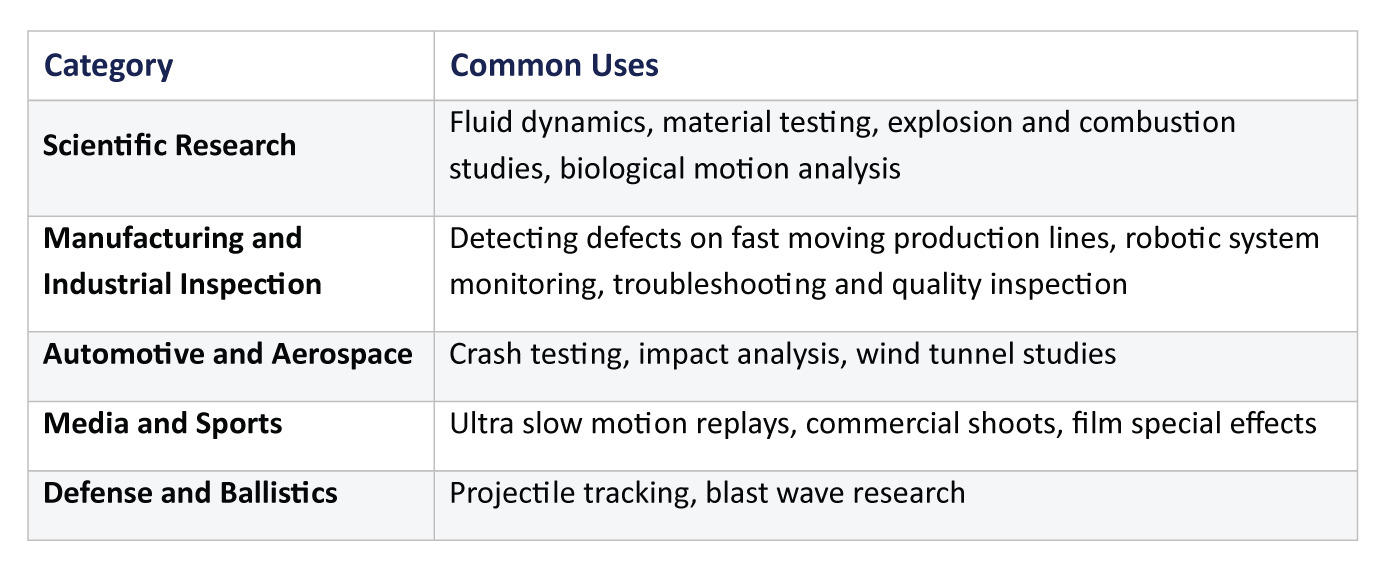
Here is an organized view of where high speed cameras are used across industries:
Choosing the Right High Speed Camera
Before investing in a high speed camera, it is important to understand the frame rate your application requires. Different motion events need different fps levels, and this will influence the type of camera you choose. You should also consider the resolution needed for clear analysis, since higher resolution provides more detail but can limit the maximum frame rate the camera can achieve.
Lighting conditions are another major factor. Evaluate the camera’s sensor sensitivity and its ability to perform in low light environments, especially if your setup cannot accommodate strong illumination. Lens compatibility also matters, particularly if your work requires specialized optics or very large aperture lenses.
Budget and data workflow are equally important. Industrial high speed cameras typically range from 5,000 to 150,000 USD, so it is essential to match performance needs with available resources. Additionally, ensure that your storage and data transfer setup can handle the large volumes of footage produced during high speed recording. By aligning these considerations with your intended use, you can select a system that delivers the right balance of performance, efficiency, and value.
Conclusion
High speed cameras offer a view into a world of motion that the human eye cannot see. Whether in scientific research, industrial diagnostics, sports, or cinematography, these tools reveal important details for understanding, troubleshooting, and storytelling. With the right combination of fps, sensor technology, lighting, and lenses, high speed imaging becomes a powerful and insightful part of any workflow.
