
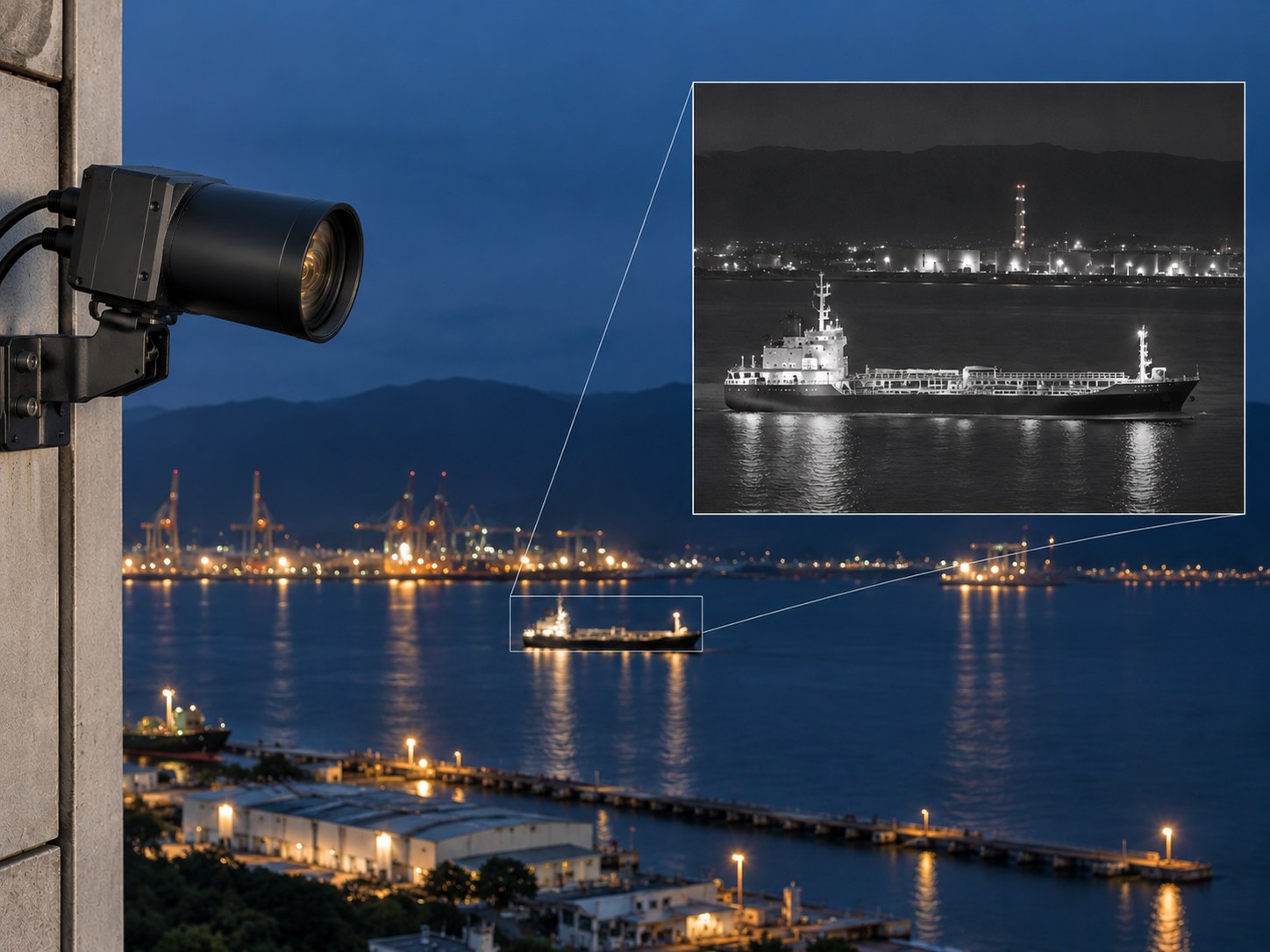
SWIR Cameras with Zoom Lenses: A New Approach to Long-Range Surveillance
Long-range surveillance has traditionally relied on visible cameras, Long-Wave Infrared (LWIR), and Mid-Wave Infrared (MWIR) imaging systems. Each technology has its strengths, but the requirements of modern surveillance are changing. Security teams increasingly need higher resolution, longer-range identification, better performance in challenging visibility conditions, and systems that can deliver these capabilities without the cost and complexity associated with high-end thermal imaging.
This is where Short-Wave Infrared (SWIR) cameras with high-performance zoom lenses are gaining attention.
By combining high-resolution SWIR sensors with long-focal-length optics, it is possible to build surveillance systems capable of delivering highly detailed monochromatic imagery at extremely long distances. In some configurations, SWIR lenses can reach focal lengths of up to 2,500 mm, opening up new possibilities for border security, maritime surveillance, critical infrastructure protection, and other long-range observation applications.
What Is SWIR Imaging?
SWIR, or Short-Wave Infrared, generally refers to infrared wavelengths around the 0.9–1.7 μm range in commonly used InGaAs-based cameras. It occupies a position between visible/NIR imaging and traditional thermal infrared technologies such as MWIR and LWIR.
One of the most important differences is how SWIR creates an image.
Unlike thermal cameras, which primarily detect infrared radiation associated with an object’s temperature, SWIR cameras generally capture reflected SWIR radiation. The result is a monochromatic image that can contain significant scene detail and contrast.
This makes SWIR particularly interesting for applications where the objective isn’t simply to determine whether a target is present, but to identify and observe the target with as much visual detail as possible.
Why Pair SWIR with a Zoom Lens?
The capabilities of a camera are only part of the equation in long-range surveillance. The optical system has an equally important role.
A high-resolution SWIR sensor combined with a long-focal-length zoom lens can produce an extremely narrow field of view, allowing operators to examine distant targets in considerably greater detail.
For example, while many high-resolution LWIR & MWIR systems are available in formats such as 640 × 512 or 1280 × 1024, their available optical configurations and focal lengths can place practical limitations on extreme long-distance identification. SWIR Camera resolution goes up to higher resolutions 3.2MP and 5.3MP and also offer higher fps of around 250+ fps depending on the camera interface.
The result is a powerful combination:
High-resolution sensor + extreme focal length = highly detailed long-range surveillance.
This can be valuable when monitoring distant vehicles, vessels, infrastructure, or other objects where detection alone is not sufficient.
SWIR vs. LWIR and MWIR
LWIR and MWIR remain highly capable technologies, particularly when thermal detection is the primary requirement. However, SWIR offers several advantages that can make it a compelling alternative for specific surveillance applications.
Resolution
High-resolution SWIR sensors are increasingly available, giving system designers more options when image detail is important. Higher resolution can be particularly beneficial when the surveillance requirement involves recognition and identification, rather than simply detecting a heat signature.
The LWIR and MWIR are commonly available at lower fps ranges of 30 or 60 fps, whereas SWIR cameras offer higher fps ranges with 1GigE and 10GigE interfaces for higher resolution versions.
SWIR provides an opportunity to achieve high-resolution imaging while maintaining a potentially more cost-effective system architecture.
Focal Length
One of the strongest advantages of SWIR is the availability of very long focal-length lenses.
While 300 mm-class focal lengths are commonly associated with certain long-range LWIR & MWIR configurations, SWIR optical systems can be designed with substantially longer focal lengths, with some solutions reaching approximately 2,500 mm.
For surveillance applications, this can dramatically narrow the field of view and increase the apparent size of distant targets.
High-performance MWIR and LWIR systems can involve expensive sensors and specialized optical materials. Many LWIR systems, in particular, rely on germanium-based optics because of their transmission characteristics in the thermal infrared spectrum.
SWIR systems are not inherently dependent on germanium optics. SWIR-compatible optical materials provide greater flexibility in lens design, potentially reducing optical costs and making long-range, high-resolution surveillance systems more accessible.
This can be particularly important when a project requires multiple surveillance units or very long-range optical configurations.
SWIR Can See Through Certain Types of Glass
Another major advantage of SWIR for surveillance applications is its ability to image through certain types of glass.
Thermal infrared wavelengths used by LWIR and MWIR cameras can be significantly affected by conventional glass. In many cases, a thermal camera cannot simply be placed behind an ordinary window and expected to produce a useful thermal image.
SWIR wavelengths, however, can transmit through many common types of glass, although performance depends on the specific glass composition, coatings, wavelength and optical system.
In case of surveillance applications, LWIR is limited by not being able to see through glass of a moving vehicle, whereas, SWIR allows to see (through the glass) the activities inside a moving vehicle making it more reliable for modern day surveillance.
A SWIR camera can potentially be installed behind a protective window or observation enclosure while continuing to monitor the external environment. This can simplify installation in applications where placing the camera outside is difficult or undesirable.
Potential applications include security control rooms, protected observation posts, vehicle-mounted systems, industrial facilities and other surveillance environments.
Performance in Challenging Weather and Visibility Conditions
Long-range surveillance rarely takes place under perfect conditions. Haze, mist, smoke, dust, low light and glare can all reduce the effectiveness of conventional visible cameras.
SWIR can offer useful advantages in several of these conditions because of the way SWIR wavelengths interact with atmospheric particles and surfaces.
In particular, SWIR can provide improved contrast compared with visible imaging in certain haze, smoke and low-light scenarios. This can help operators maintain useful imagery when a conventional camera begins to lose scene detail.
It is important to note that no infrared band is universally superior in every weather condition. LWIR, MWIR and SWIR each have different atmospheric characteristics and should be selected based on the actual operational environment.
The advantage of SWIR is that it can offer a different combination of visibility, detail, resolution and optical performance, particularly when paired with a high-power zoom lens.
Monochromatic Imaging for Better Target Detail
SWIR cameras typically produce monochromatic imagery rather than the thermal-style images associated with LWIR and MWIR.
For many surveillance applications, this can actually be an advantage.
The imagery can resemble a highly detailed grayscale image, making it easier for operators to interpret objects, structures and scene characteristics. Instead of relying primarily on temperature differences, SWIR can reveal reflected-light information that may provide useful visual context.
This distinction is important:
Thermal imaging answers: “What is generating or retaining heat?”
SWIR imaging answers: “What can we observe from the reflected SWIR signal?”
For identification-focused surveillance, that difference can be significant.
Applications for SWIR Long-Range Surveillance
The combination of high-resolution SWIR sensors and long-focal-length zoom lenses can support a wide range of applications.
Border and Perimeter Security
Long-range SWIR systems can monitor distant vehicles, people and activity across large areas while providing detailed imagery for identification.
Maritime Surveillance
Coastal security teams can use long-range SWIR cameras to observe vessels and offshore infrastructure from significant distances.
Critical Infrastructure
Power plants, pipelines, ports, airports and industrial facilities can benefit from high-resolution surveillance across large perimeters.
Security and Law Enforcement
The ability to operate in low-light conditions and, in suitable circumstances, image through glass can provide additional deployment flexibility.
Choosing the Right SWIR Zoom System
When evaluating a SWIR surveillance camera, the sensor should not be considered independently from the lens.
Key specifications include:
- Sensor resolution and pixel pitch
- SWIR wavelength range
- Sensor sensitivity
- Minimum and maximum focal length
- Optical zoom ratio
- Field of view
- Image stabilization
- Low-light performance
- Transmission through protective glass
- Environmental protection
- Camera size and weight
- Integration with PTZ and surveillance systems
The right combination of sensor resolution and focal length is especially important for long-range applications. A high-resolution sensor alone does not guarantee long-distance identification, just as an extremely long lens cannot compensate for insufficient sensor performance.
The Future of Long-Range Surveillance
LWIR and MWIR will continue to play an important role wherever thermal detection is essential. However, not every surveillance application requires thermal information.
For applications where high resolution, extreme magnification, detailed monochromatic imagery and cost efficiency are priorities, SWIR presents an increasingly attractive option.
The ability to combine high-resolution SWIR sensors with focal lengths reaching approximately 2,500 mm creates opportunities for surveillance systems that can observe and identify targets at exceptional distances.
With its potential cost advantages, flexibility in optical materials, ability to image through certain types of glass, and strong performance in selected low-light and atmospheric conditions, SWIR deserves consideration alongside traditional LWIR and MWIR technologies.
The future of long-range surveillance may not be about choosing one infrared technology for every application. Instead, it will be about selecting the right imaging band, sensor resolution and optical architecture for the mission.
And for applications where long-range identification and high-resolution imagery are the priority, SWIR with a high-performance zoom lens can offer a compelling alternative to conventional thermal imaging
