
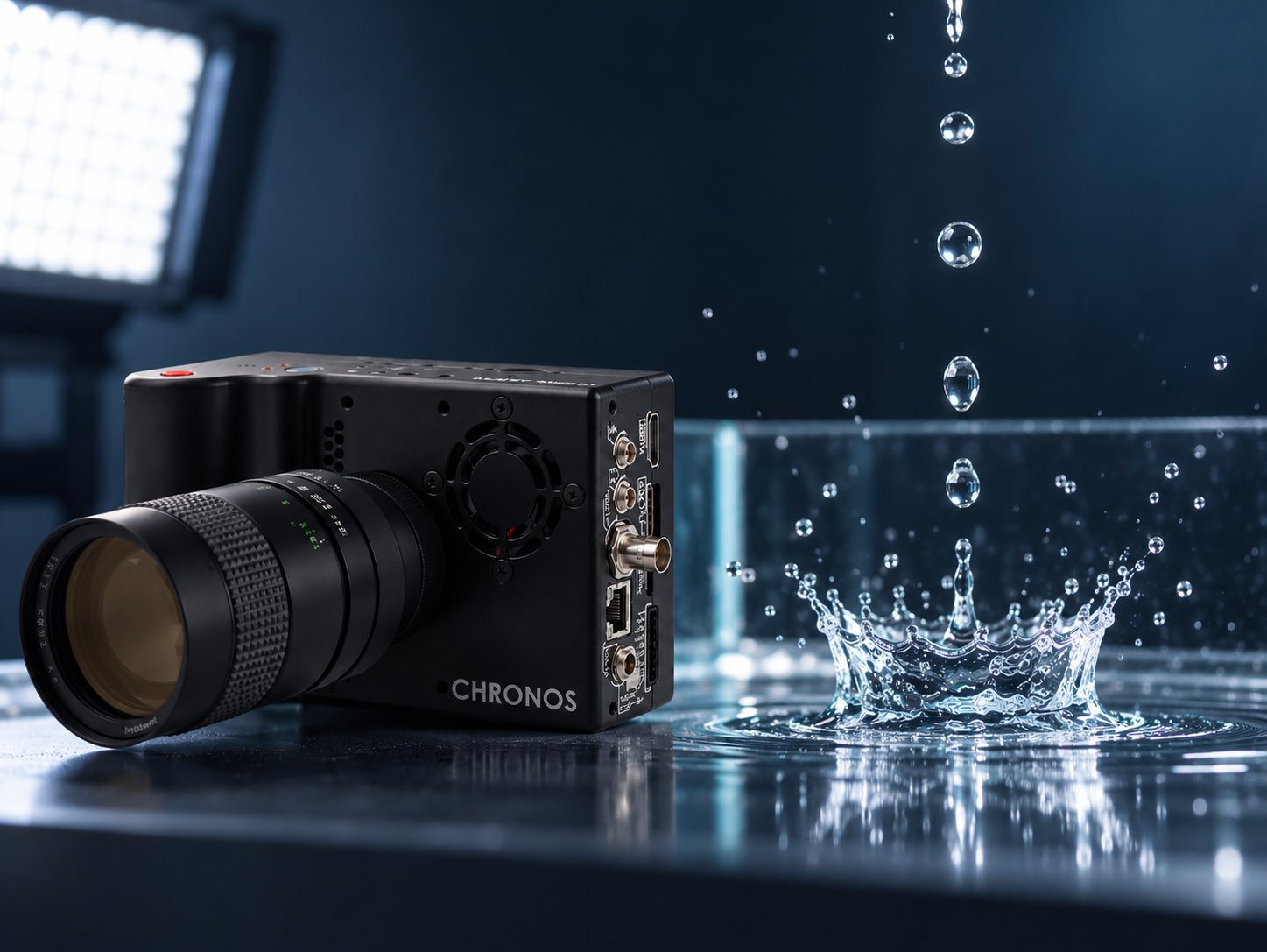
High-Speed Cameras for Fluid Dynamics: Applications & Benefits
Fluid dynamics involves some of the fastest and most complex phenomena in engineering and scientific research. Droplets break apart in milliseconds, bubbles can collapse almost instantaneously, and turbulent flow can produce constantly changing vortices and instabilities. These events are often too fast for the human eye and conventional cameras to capture in meaningful detail.
High-speed cameras provide a way to make these transient events visible. By recording thousands of frames per second and playing the footage back in slow motion, researchers and engineers can observe how a fluid behaves from one moment to the next.
Chronos High Speed Cameras offer a practical imaging solution for a wide range of fluid dynamics applications, from droplet and spray analysis to cavitation, jet breakup and turbulence studies.
Why High-Speed Imaging Matters in Fluid Dynamics
A conventional video camera may capture an event at 30 or 60 frames per second. While this is sufficient for everyday video, it can be inadequate for studying rapidly changing fluid behavior.
Consider a droplet striking a surface. The entire process, from initial impact to spreading, splashing and the formation of secondary droplets, can happen within a few milliseconds. At normal recording speeds, much of this process appears instantaneous.
A high-speed camera changes this perspective.
By capturing hundreds, thousands or even more frames per second, researchers can break a fast event into individual stages. The resulting footage can then be played back slowly, allowing each stage to be examined and measured.
This provides valuable information about when an event occurs, how it develops and what happens immediately before and after it.
Chronos High-Speed Cameras for Fluid Dynamics
Chronos High Speed Cameras are designed to capture fast-moving events while providing the resolution and frame rates needed for detailed analysis.
For fluid dynamics experiments, several camera characteristics are particularly important:
- High frame rates for capturing rapid fluid movement
- High-speed recording for short-duration events
- Resolution options for observing both large-scale and fine fluid structures
- Short exposure times to reduce motion blur
- Compatibility with different lenses and optical setups
- Immediate playback for reviewing experimental results
The right combination of frame rate, resolution, exposure and lighting allows researchers to obtain clear images even when studying extremely fast fluid behavior.
Applications of High-Speed Cameras in Fluid Dynamics
1. Droplet Formation and Breakup
Droplet behavior is an important area of research across industries including printing, pharmaceuticals, coatings, fuel injection and manufacturing.
High-speed imaging can capture:
- Droplet formation from nozzles
- Droplet collision
- Droplet deformation
- Droplet breakup
- Droplet impact on surfaces
- Splashing and secondary droplet formation
Instead of simply observing the final shape of a droplet, researchers can examine the entire process frame by frame. This can help determine breakup times, droplet velocities, deformation patterns and other characteristics.
2. Spray and Atomization Analysis
Spray systems are widely used in fuel injection, agriculture, painting, cooling, coating and many industrial processes.
The atomization process can happen extremely quickly as a liquid jet breaks into smaller droplets. High-speed cameras allow engineers to visualize this process and examine how changes in nozzle geometry, pressure and flow conditions affect spray behavior.
High-speed footage can reveal:
- Spray cone development
- Jet breakup
- Droplet formation
- Spray penetration
- Instabilities
- Changes in spray structure
This information can help engineers optimize nozzle and spray system designs.
3. Cavitation and Bubble Dynamics
Cavitation occurs when vapor bubbles form and subsequently collapse within a liquid. The phenomenon is particularly important in pumps, propellers, turbines, valves and hydraulic systems.
Bubble formation and collapse can happen extremely rapidly, making high-speed imaging particularly useful.
A Chronos camera can capture the progression of a bubble from formation and growth through collapse, helping researchers understand the mechanisms behind cavitation damage, pressure changes and fluid disturbances.
High-speed footage can also help engineers evaluate equipment designs and identify potentially damaging cavitation behavior.
4. Fluid Jets and Jet Breakup
Liquid jets are used in numerous industrial and scientific applications. Depending on flow conditions and nozzle design, a continuous jet can become unstable and eventually break into droplets.
High-speed cameras allow researchers to observe this transition in detail.
They can be used to study:
- Jet velocity
- Jet shape
- Surface instabilities
- Breakup length
- Droplet formation
- Effects of nozzle geometry
Capturing the complete breakup process provides insights that may be difficult to obtain from conventional imaging or individual photographs.
5. Splashing and Impact Phenomena
When a liquid hits a solid or another liquid, a series of extremely fast events can occur. A droplet can flatten, spread across a surface, form a crown-like splash and generate secondary droplets, all within milliseconds.
High-speed cameras make it possible to visualize this sequence:
Impact → spreading → deformation → splashing → secondary droplets
This type of imaging is useful in research involving rain impacts, coatings, inkjet printing, spray deposition and liquid dispensing.
6. Turbulence and Vortex Formation
Turbulent flow is characterized by constantly changing structures and vortices. High-speed imaging can provide a visual record of how these structures develop and interact.
Researchers can use high-speed footage to investigate:
- Vortex formation
- Flow separation
- Wake behavior
- Shear-layer instabilities
- Rapid changes in flow patterns
High-speed imaging can also complement other experimental techniques, such as flow visualization and Particle Image Velocimetry (PIV).
From Visualization to Measurement
One of the biggest advantages of high-speed imaging is that the resulting footage can provide more than just a visual demonstration.
Individual frames can be analyzed to extract useful measurements, including:
- Droplet size
- Droplet velocity
- Jet velocity
- Breakup time
- Bubble size
- Bubble growth and collapse
- Splash height
- Spray penetration
- Movement of particles or tracers
By comparing successive frames, researchers can establish how a phenomenon changes over time and use that information to validate simulations, compare experimental conditions or optimize equipment.
Choosing the Right High-Speed Setup
Selecting a high-speed camera is only one part of building an effective fluid dynamics imaging system.
- Frame rate determines how much temporal detail can be captured. Faster phenomena require higher frame rates.
- Resolution becomes particularly important when examining small droplets, bubbles or fine flow structures.
- Exposure time must be short enough to minimize motion blur. However, shorter exposures allow less light to reach the sensor, making illumination critical.
- Lens selection also affects the results. Macro or microscope-based optics may be appropriate for small-scale fluid experiments, while longer focal-length lenses can be useful for larger experimental setups.
- Finally, lighting can be just as important as camera speed. High-intensity LED or strobe illumination can help produce sharp, well-defined images during very short exposures.
Conclusion
Fluid dynamics is often about understanding what happens in a fraction of a second. Droplets form and break apart, bubbles collapse, jets become unstable and vortices develop before conventional cameras can capture the details.
High-speed cameras make these otherwise fleeting processes visible.
With their combination of high-speed recording, resolution and flexible imaging configurations, Chronos High Speed Cameras can be used across a broad range of fluid dynamics applications, from droplet and spray analysis to cavitation, jet breakup and turbulence research.
By turning milliseconds of fluid behavior into detailed slow-motion footage, high-speed imaging gives researchers and engineers a powerful way to observe, understand and measure fast fluid phenomena.
