
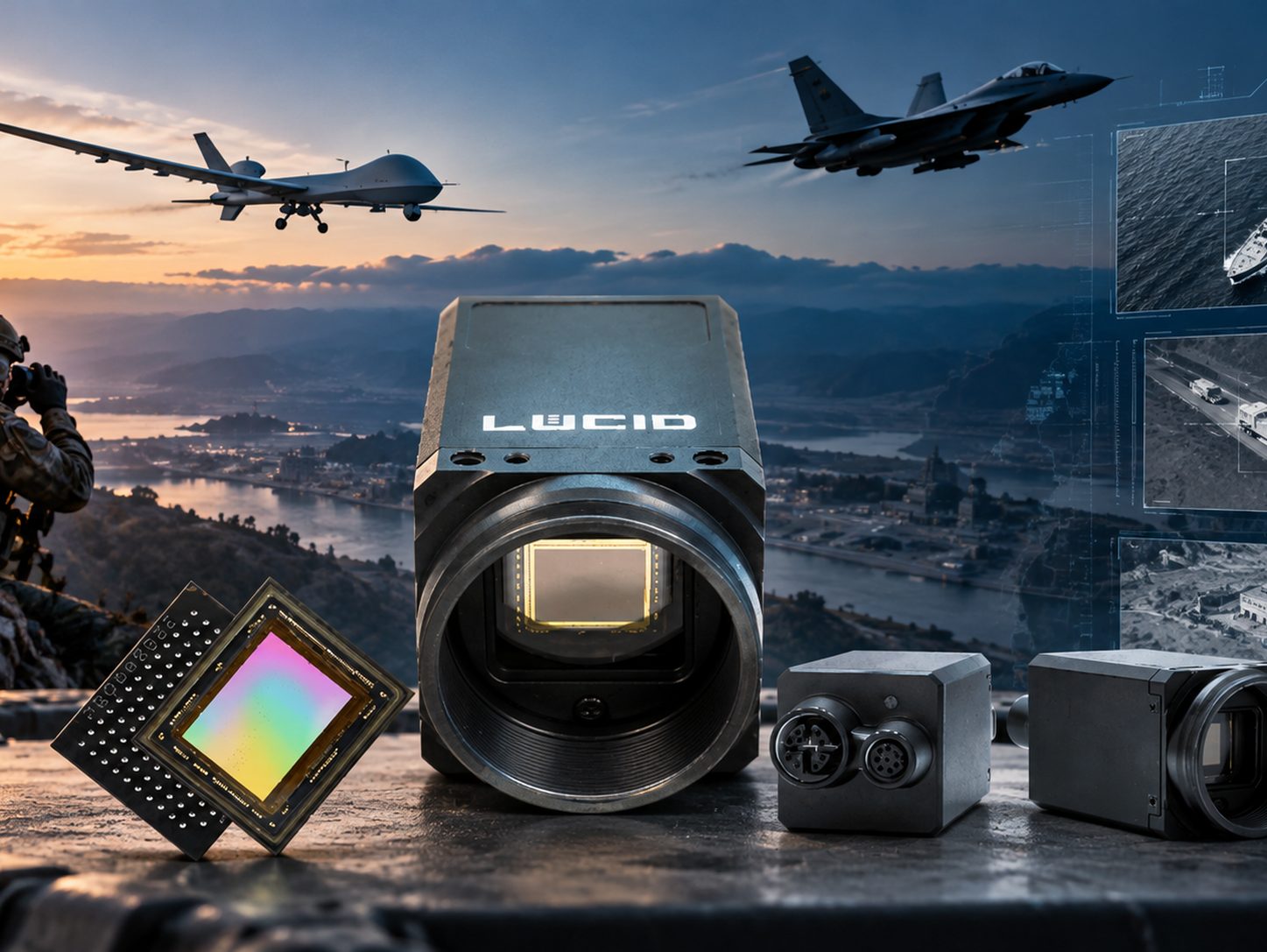
How Event-Based Vision Is Redefining Defence & Aerospace Operations
When the threat is airborne, uncertainty is the enemy. In contested airspace, the difference between mission success and mission failure often comes down to milliseconds, how quickly a system can detect a fast-moving object, classify it, and hand off a decision to the operator or the platform itself. Traditional camera systems, built for capturing scenes rather than reacting to them, are increasingly strained by this demand.
Small drones move fast and erratically. Adversaries operate in degraded, GPS-denied, and electronically contested environments. And every gram and milliwatt added to a platform’s sensor payload comes at a real operational cost. This is the problem event-based vision was built to solve.
What Makes Event-Based Vision Different
Conventional cameras capture the world in frames, full images taken at fixed intervals, whether or not anything in the scene has changed. This approach works well for photography, but it’s fundamentally mismatched to the demands of defence and aerospace sensing, where the moments that matter most are exactly the ones that happen between frames.
Event-based vision flips the model. Instead of capturing full frames on a clock, each pixel independently reports a change in brightness the instant it happens. The result is a sensor that responds to motion in near real time, rather than sampling it periodically.
The performance gains this unlocks are substantial:
- Greater than 10kHz equivalent temporal resolution: capturing motion far faster than standard video frame rates allow
- Greater than 140dB dynamic range: enabling reliable performance from bright daylight to near-total darkness, and from full sun to backlit conditions that would blind conventional cameras
- Sub-1ms sensor latency: critical for time-sensitive detection and response
- A 4x5mm sensor and 0.13g camera module: a footprint small enough to embed in the tightest platforms
- Under 2mW power consumption during active sensing, a fraction of what conventional imaging demands
Together, these characteristics describe a sensor built not to record the world, but to react to it, which is precisely what’s needed when the threat is airborne and time is the scarcest resource.
Why Industry Leaders Trust This Approach
Event-based vision isn’t a lab curiosity being pitched on promise alone. It’s already embedded in the sensing stacks of established defence and aerospace players, organizations like Thales, Anduril, Leonardo, Xsight, ZEOPTIC, SAQZ, and Flyability, among others. That breadth matters: it signals a technology that has been tested against real operational requirements across multiple platform types, rather than one built around a single use case or customer.
Where Event-Based Vision Is Already at Work
Rather than a single application, event-based sensing is being deployed across a range of defence and aerospace problems, each with its own constraints.
Multimodal RGB / Event-Based Drone Detection
Drone detection is one of the clearest cases for combining sensing modalities. Frame-based RGB cameras and event-based sensors each bring different strengths and limitations, frame-based systems offer familiar imagery and context, while event-based sensors excel at picking out fast, subtle motion that conventional frame rates miss entirely. Fusing the two into a single detection pipeline compensates for the individual weaknesses of either approach, producing more reliable detection across a wider range of conditions than either technology could deliver alone.
GPS-Denied Navigation
In contested or jammed environments, platforms can’t rely on satellite positioning. Event-based vision supports resilient absolute positioning using terrain and visual features rather than external signals, is inherently resistant to the kind of interference that disrupts RF-based systems, and requires minimal data storage and processing overhead, an important consideration for platforms with constrained onboard compute. It’s also passive by nature, meaning it doesn’t emit a signal that could give away a platform’s position.
Multimodal Sensing Platforms
Combining event-based sensors with complementary imaging modalities, including long-range and polarization-based sensing, extends situational awareness across a wider range of distances and environmental conditions. This kind of layered sensing approach is particularly valuable for platforms that need to maintain awareness across highly variable operating environments without dramatically increasing size, weight, or power demands.
AI-Based Target Recognition
Detection is only half the problem; classification is the other. Pairing event-based sensor output with AI-driven recognition models enables faster, more reliable target classification, helping operators and autonomous systems distinguish real threats from background clutter or benign objects, and do so with the speed the underlying sensor makes possible.
Space-Based Observation and Space Situational Awareness
The same properties that make event-based vision valuable in atmospheric defence, high dynamic range, low latency, minimal power draw, translate directly to the orbital domain. Space-based platforms face extreme lighting conditions and tight payload budgets, making event-based sensing well suited to space situational awareness and orbital observation missions where traditional imaging systems struggle with both dynamic range and power constraints.
Combining with Optics based on your surveillance or application need
The event-based camera optics or lens selection is same as frame based. Depending on your application need you can choose a wide-angle lens for navigation and longer focal length for long distance imaging. Event based cameras can come with standard C Mount, allowing any C mount longer focal length lens to be used to cover long distance. Event based sensor modules come with S Mount / M12 lenses in lower focal lengths allowing wider FOV and hence for navigation in drones, UAVs etc.
The Common Thread: Speed, Size, and Efficiency
Across every one of these applications, the same underlying advantages recur. Faster reaction time. Smaller sensor footprint. Lower power draw. These aren’t incidental benefits, they’re the direct product of how event-based sensors work, and they map directly onto the constraints that define modern defence and aerospace platforms. Whether it’s a small UAV with a strict weight budget, a satellite with limited onboard power, or a ground-based system that needs to detect a threat before it can react, the calculus is the same: SWaP (size, weight, and power) constraints are non-negotiable, and sensing technology has to work within them rather than around them.
Real-World Validation
This isn’t a niche technology operating outside the mainstream conversation. Coverage from outlets including EE Times, VentureBeat, Scientific American, and Gartner reflects growing recognition that event-based vision represents a meaningful shift in how sensing systems are designed, not just for defence, but across industries where speed and efficiency matter.
Final Words: Operating Smarter in an Uncertain Domain
The core proposition is simple: when the threat is airborne, uncertainty is the enemy, and reaction time is the antidote. Event-based vision doesn’t just improve on existing sensing approaches incrementally, it changes what’s detectable in the first place, surfacing fast, subtle motion that conventional cameras are structurally unable to capture.
For defence and aerospace programs evaluating next-generation sensing options, the question worth asking isn’t whether event-based vision will play a role in future platforms, it’s how soon it should play a role in yours.
