Particle Image Velocimetry (PIV): How Chronos High-Speed Cameras Enable Accurate Flow Analysis
Understanding how fluids move is fundamental to improving the performance of aircraft, automobiles, industrial machinery, and even medical devices. Engineers and researchers rely on precise flow measurement techniques to analyze velocity, turbulence, mixing, and aerodynamic performance. Among the many available methods, Particle Image Velocimetry (PIV) has become one of the most trusted optical techniques for capturing detailed flow behavior without disturbing the fluid itself.
At the heart of every successful PIV system is a high-speed camera capable of capturing rapidly moving particles with exceptional clarity and precision. In this article, we’ll explore what Particle Image Velocimetry is, why high-speed imaging is essential, and how Chronos High-Speed Cameras provide a practical and cost-effective solution for many PIV applications.
What is Particle Image Velocimetry (PIV)?
Particle Image Velocimetry (PIV) is a non-contact optical measurement technique used to visualize and quantify the velocity of fluids. Instead of inserting probes or sensors into the flow, PIV uses microscopic tracer particles that faithfully follow the movement of the fluid.
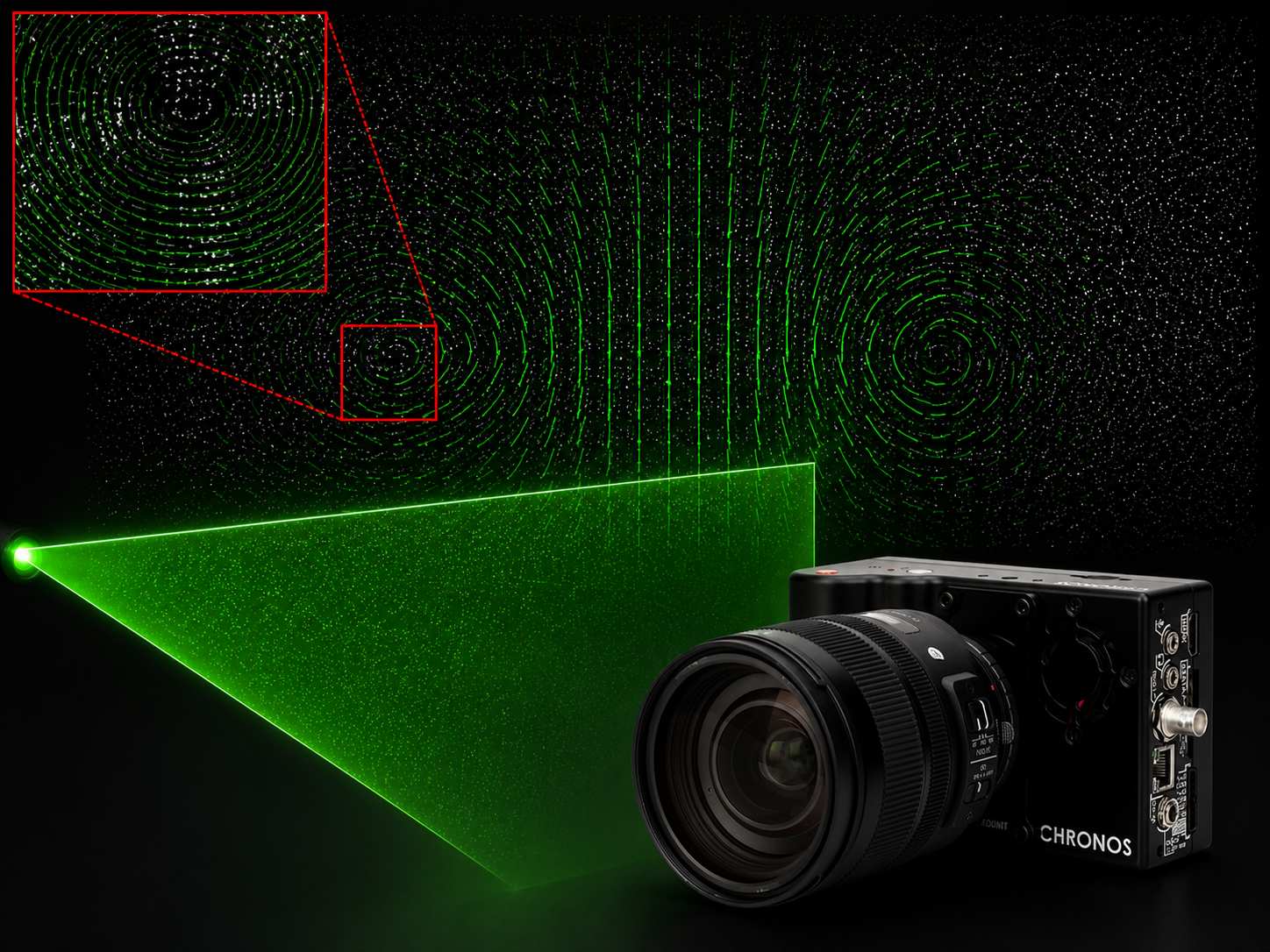
The process begins by introducing these particles into the liquid or gas under investigation. A thin sheet of laser light illuminates the particles while a high-speed camera captures two or more images in rapid succession. Specialized PIV software then compares the displacement of particle groups between consecutive frames to calculate velocity vectors across the entire field of view.
Unlike point measurement techniques, PIV provides a complete velocity map, allowing researchers to study complex flow structures, vortices, turbulence, and transient events with remarkable accuracy.
Why Use Particle Image Velocimetry?
PIV has become a preferred measurement technique because it delivers comprehensive flow information while leaving the flow undisturbed.
Some of its key advantages include:
- Non-invasive and non-contact measurement
- Full-field velocity mapping instead of single-point data
- High spatial and temporal resolution
- Accurate visualization of turbulent and transient flows
- Repeatable experimental results
- Compatibility with both liquid and gas flow studies
These capabilities make PIV invaluable for both academic research and industrial product development, where understanding fluid behavior is critical for improving performance and efficiency.
Common Applications of PIV
Particle Image Velocimetry is used across a wide range of industries and research disciplines.
Aerospace
Engineers use PIV during wind tunnel testing to study airflow around wings, fuselage designs, propellers, and turbine components. The technique helps optimize aerodynamic efficiency while reducing drag and improving fuel economy.
Automotive
Vehicle manufacturers employ PIV to analyze airflow around cars, cooling systems, intake manifolds, and exhaust components. Understanding these flow patterns leads to better vehicle performance and thermal management.
Industrial Research
Chemical processing, mixing systems, combustion studies, spray characterization, and heat exchanger design all benefit from accurate flow visualization provided by PIV.
Biomedical Engineering
Researchers use PIV to investigate blood flow, respiratory airflow, cardiovascular devices, and microfluidic systems. Since the technique is non-contact, it is particularly suitable for delicate biomedical experiments.
Academic Research
Universities and research laboratories rely extensively on PIV for teaching fluid mechanics, validating computational fluid dynamics (CFD) models, studying turbulence, and investigating complex flow phenomena.
Why High-Speed Cameras Matter in PIV
While lasers and software are essential components of a PIV system, the camera ultimately determines the quality of the captured data.
Fluid motion often occurs at extremely high speeds, particularly in turbulent flows, combustion processes, and aerodynamic testing. If the camera cannot capture images quickly enough, particle movement becomes blurred, making accurate velocity calculations difficult or impossible.
An effective PIV camera should provide:
- High frame rates for capturing fast-moving particles
- Short exposure times to minimize motion blur
- Global shutter operation to eliminate image distortion
- High sensitivity for low-light laser illumination
- High image quality for reliable correlation analysis
- External triggering for synchronization with pulsed laser systems
Choosing the right camera directly impacts the accuracy, repeatability, and reliability of PIV measurements.
What to Look for in a PIV Camera
Selecting a camera for PIV involves balancing speed, image quality, and synchronization capabilities.
Some of the most important features include:
High Frame Rates: Faster frame rates allow the camera to capture rapidly changing flow events without missing critical particle movement.
Global Shutter Sensor: A global shutter exposes all pixels simultaneously, preventing geometric distortion that can affect velocity calculations.
High Sensitivity: Since laser illumination may be brief, cameras with excellent light sensitivity produce clearer particle images and improve measurement accuracy.
Flexible Resolution: Different experiments require different trade-offs between image resolution and frame rate. A flexible camera allows researchers to optimize both.
External Triggering: Precise synchronization between the camera and laser pulses ensures accurate image acquisition throughout the experiment.
Why Chronos High-Speed Cameras are a Great Fit for PIV
Chronos High-Speed Cameras have become increasingly popular among universities, research laboratories, and industrial R&D teams because they deliver impressive performance at a fraction of the cost of many traditional scientific high-speed cameras.
High-Speed Imaging Performance
Chronos cameras are capable of capturing thousands of frames per second, making them suitable for recording fast-moving particles in a wide range of laboratory experiments. This enables researchers to study transient flow events that would be impossible to observe using conventional cameras.
Global Shutter Technology
Accurate particle positioning is essential for reliable velocity calculations. The global shutter architecture found in Chronos cameras ensures that every pixel is exposed simultaneously, reducing motion artifacts and improving measurement precision.
Excellent Image Quality
Sharp particle images are critical for PIV software to accurately determine particle displacement. Chronos cameras provide high-quality image capture that supports reliable correlation analysis across many experimental conditions.
Flexible Resolution and Frame Rate
Researchers can adjust image resolution to achieve higher frame rates when studying extremely fast phenomena or prioritize spatial detail when investigating slower flows. This flexibility makes Chronos suitable for a wide variety of experimental setups.
Easy Synchronization
Chronos cameras support external triggering, allowing them to synchronize with laser systems and other laboratory equipment. Proper timing between illumination and image acquisition is essential for obtaining accurate PIV measurements.
Multi Camera Synchronization
For stereo and 3D PIV applications, multiple Chronos High-Speed Cameras can be externally triggered and synchronized to capture images simultaneously from multiple viewpoints. This ensures precise timing with laser pulses for accurate flow measurement and reliable velocity analysis.
Compact and Portable Design
Many research laboratories have limited workspace around experimental rigs. The compact design of Chronos cameras allows them to be integrated into existing optical setups with minimal effort.
Exceptional Value for Research Laboratories
Perhaps the greatest advantage of Chronos cameras is their affordability. Many universities, educational institutions, and small research teams can access professional high-speed imaging capabilities without the significant investment typically associated with scientific imaging systems.
For teaching laboratories, proof-of-concept experiments, fluid mechanics research, and industrial development projects, Chronos offers an excellent balance of performance and cost.
Typical PIV Workflow Using a Chronos Camera
A typical PIV experiment using a Chronos camera follows these steps:
- Introduce tracer particles into the fluid.
- Illuminate the particles using a pulsed laser sheet.
- Capture consecutive particle images with the Chronos high-speed camera.
- Transfer the images to PIV processing software.
- Generate velocity vectors and flow field visualizations for analysis.
This workflow enables researchers to accurately study flow characteristics such as velocity, turbulence intensity, vortex formation, and mixing behavior.
Conclusion
Particle Image Velocimetry has transformed the way engineers and researchers study fluid motion by providing accurate, non-contact, full-field velocity measurements. Whether investigating airflow over an aircraft wing, optimizing industrial mixing processes, or studying biomedical flows, PIV delivers valuable insights that drive innovation.
The success of any PIV experiment depends heavily on the imaging system. A high-speed camera with excellent frame rates, image quality, synchronization capabilities, and reliability is essential for capturing accurate particle motion.
Chronos High-Speed Cameras combine these capabilities with exceptional affordability, making them an attractive choice for universities, research laboratories, educators, and industrial R&D teams seeking a powerful yet cost-effective solution for Particle Image Velocimetry applications. As demand for advanced flow visualization continues to grow, Chronos cameras provide an accessible platform for high-quality PIV experiments without compromising on performance.
