Hyperspectral vs. SWIR Cameras: Differences and Applications in Machine Vision
Machine vision is no longer limited to visible-light imaging. Technologies such as hyperspectral and Shortwave Infrared (SWIR) imaging allow industrial inspection systems to capture information beyond what conventional cameras can detect.
Although both technologies extend imaging capabilities, they work differently. Hyperspectral imaging captures information across numerous narrow wavelength bands to identify materials based on their spectral signatures, while SWIR cameras capture intensity information within the shortwave infrared region to detect specific material characteristics and defects.
Understanding these differences helps manufacturers and system integrators select the right imaging technology for applications such as food inspection, pharmaceutical quality control, semiconductor inspection, and automated material sorting.
Hyperspectral vs. SWIR Cameras: Understanding the Difference
What Is a Hyperspectral Camera?
A hyperspectral camera captures images across numerous narrow, continuous spectral bands, providing detailed information about how different materials interact with light.
Unlike conventional cameras that capture three colour channels (red, green, and blue), hyperspectral cameras collect information across dozens or even hundreds of wavelength bands.
The resulting output is a three-dimensional dataset known as a hyperspectral data cube, containing:
- X-axis: Horizontal spatial information.
- Y-axis: Vertical spatial information.
- Spectral axis: Information across multiple wavelengths.
Each pixel contains a spectral signature representing how the corresponding material reflects, absorbs, or transmits light across the captured wavelengths.
These signatures can be analysed to identify materials, detect chemical variations, and classify objects. Depending on the detector configuration, hyperspectral cameras can operate across visible, Near Infrared (NIR), and Shortwave Infrared (SWIR) regions.
What Is a SWIR Camera?
A Shortwave Infrared (SWIR) camera captures light in the shortwave infrared region of the electromagnetic spectrum. Common InGaAs-based systems typically cover approximately 900–1700 nm, although specialised systems can extend further to 2000 or 2500nm.
SWIR cameras use sensors designed to detect infrared radiation. Indium Gallium Arsenide (InGaAs) is a commonly used sensor technology.
Different materials interact with infrared wavelengths differently. Consequently, materials that appear similar under visible illumination may produce distinct intensity responses under SWIR illumination.
SWIR cameras can help detect moisture variations, differentiate certain materials, inspect semiconductor components, and identify defects that are difficult to detect using conventional cameras.
Most conventional SWIR cameras produce two-dimensional intensity images rather than independently capturing numerous narrow spectral bands.
Key Differences Between Hyperspectral and SWIR Imaging
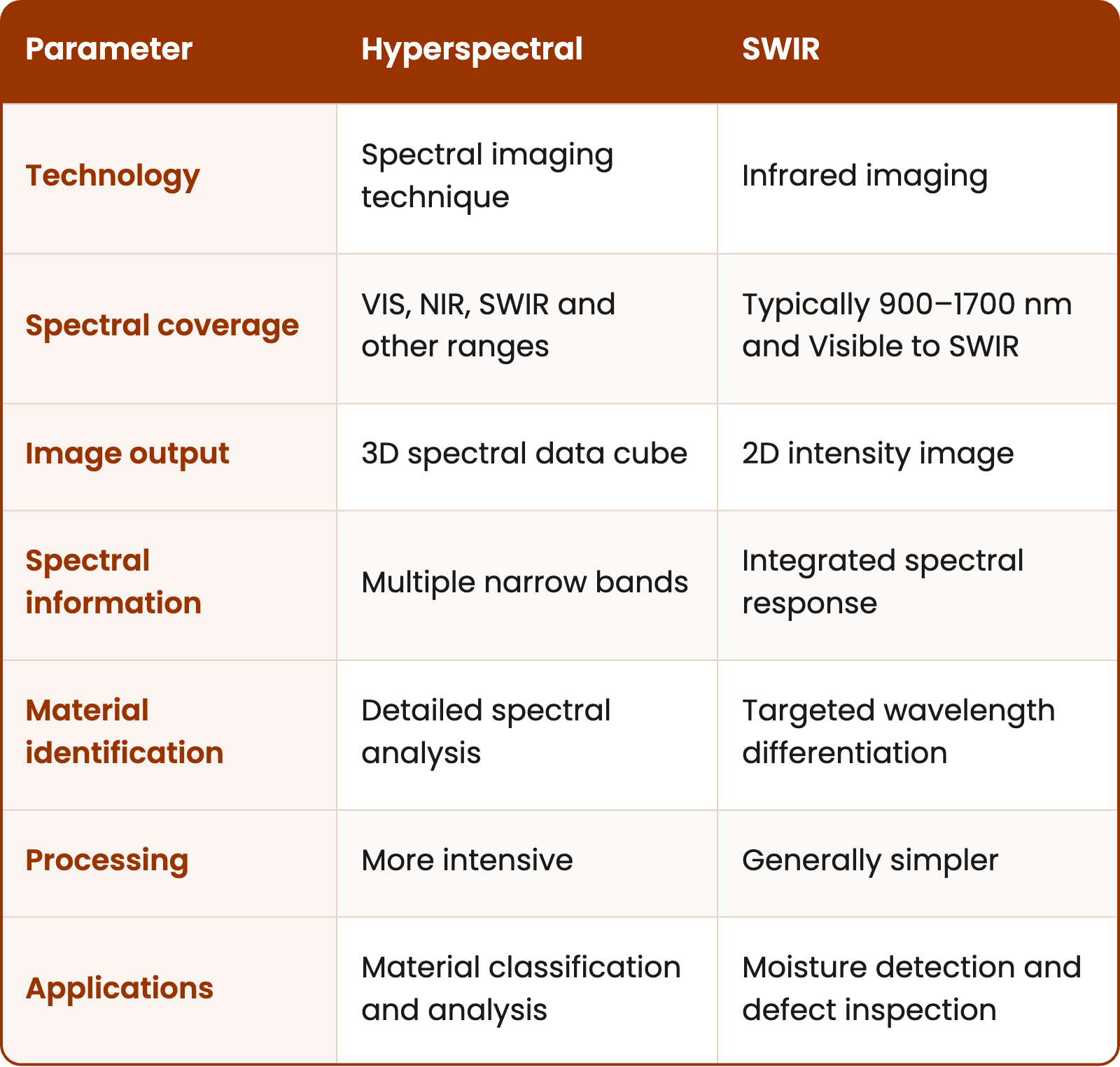
Hyperspectral and SWIR are not mutually exclusive technologies. Hyperspectral describes how spectral information is captured, while SWIR describes a wavelength region. A hyperspectral camera can therefore operate within the SWIR region.
Why Does the Spectrum Matter in Machine Vision?
Conventional industrial cameras primarily capture visible light, typically within the 400–700 nm range. However, different materials exhibit different absorption, reflection, and transmission characteristics across the electromagnetic spectrum.
These differences can reveal information that is difficult or impossible to detect using visible-light imaging.
Understanding Visible, NIR and SWIR
Three important wavelength regions for machine vision include:
- Visible (400–700 nm): Used for colour inspection, surface defects, object recognition, and conventional imaging.
- Near Infrared (approximately 700–1000 nm): Useful for inspecting certain organic materials, vegetation, and moisture-related characteristics.
- Shortwave Infrared (approximately 900–2500 nm): Useful for material differentiation, moisture detection, and wavelength-dependent inspection.
These ranges are approximate and can overlap depending on the convention and imaging system.
Visible + NIR: Extending Conventional Machine Vision
Combining visible and NIR imaging provides conventional visual information alongside additional infrared characteristics.
While visible imaging identifies colours, shapes, and surface conditions, NIR reveals differences in how materials reflect or absorb near-infrared light.
Applications include:
- Agriculture: Evaluating vegetation and crop conditions.
- Food inspection: Identifying selected quality variations.
- Industrial inspection: Differentiating certain materials.
- Pharmaceuticals: Inspecting material and coating variations.
Visible + SWIR: Seeing Beyond the Visible Spectrum
SWIR imaging provides access to additional wavelength-dependent material characteristics. Water, for example, exhibits absorption features at several SWIR wavelengths, making this technology useful for detecting moisture variations.
Combining visible and SWIR imaging can help identify material differences, inspect silicon wafers, detect certain subsurface features, and identify defects that are difficult to distinguish under visible illumination.
Applications of Hyperspectral Cameras in Machine Vision
Hyperspectral imaging is particularly useful when industrial inspection requires detailed material identification and classification rather than simply detecting a specific feature.
Recycling and Industrial Material Inspection
Hyperspectral cameras can differentiate materials based on their spectral signatures, even when they have similar visible appearances. The material spectrum of waste is different and can carry plastics, organic materials like wood, paper, food and other metal components.
Applications include identifying plastic polymers, classifying mixed materials, detecting contamination, and analysing industrial material composition.
Food Inspection and Sorting
Hyperspectral cameras can analyse differences in food composition, moisture, fat distribution and contamination.
Applications include:
- Identifying foreign materials and contamination.
- Food adulteration and fraud detection
- Detecting selected quality defects in fruits and vegetables.
- Supporting automated food grading and sorting.
Pharmaceutical Quality Control
Hyperspectral imaging can help pharmaceutical manufacturers analyse product composition and uniformity.
Applications include:
- Mapping active pharmaceutical ingredient distribution.
- Identifying tablet and chemical composition.
- Analysing coating uniformity.
- Detecting material inconsistencies.
Agriculture and Crop Monitoring
Plant health and condition influence vegetation’s spectral response, making hyperspectral imaging useful for agricultural analysis.
Applications include:
- Evaluating crop health and nutrient status.
- Identifying certain plant stress indicators.
- Monitoring crop maturity and growth dynamics.
- Detecting variations associated with nutrient deficiencies.
Hyperspectral or SWIR: Which Technology Should You Choose?
The choice depends on the inspection objective, material characteristics, and level of spectral information required.
Choose SWIR imaging when:
- You need targeted infrared inspection.
- Your application involves moisture detection or specific material differences.
- You need defect detection and automated sorting.
- You do not require detailed spectral information across numerous bands.
Choose hyperspectral imaging when:
- You need detailed material identification.
- Your application requires spectral signature analysis.
- You need to distinguish materials with similar visible appearances.
- You are conducting advanced research or specialised quality analysis.
Other factors to consider include inspection speed, wavelength requirements, processing capabilities, system integration, and total equipment cost.
The two technologies can also complement each other when an application requires both targeted infrared inspection and detailed spectral analysis.
Conclusion
Hyperspectral and SWIR imaging provide industrial inspection systems with capabilities beyond conventional visible-light cameras. While hyperspectral cameras offer detailed spectral information for material identification and classification, SWIR cameras are particularly useful for targeted infrared inspection, moisture detection, and material differentiation. Selecting the right solution requires considering the camera, sensor, lenses, illumination, calibration, data acquisition, and processing requirements.
